Strategic Visual Communication with Japanese Culture Icons Black White
In the landscape of modern digital communication, clarity is currency. Whether you are a small business owner refining your brand identity, an educator developing curriculum materials, or a marketer crafting a campaign, the visual assets you choose serve as silent ambassadors for your message. The Japanese Culture Icons Black White collection represents more than just a set of decorative graphics; it is a strategic tool for conveying cultural nuance, elegance, and specificity without the noise of excessive color or complex detail. By leveraging high-contrast, vector-based imagery, creators can achieve a level of professional polish that resonates with audiences seeking authenticity and sophistication.
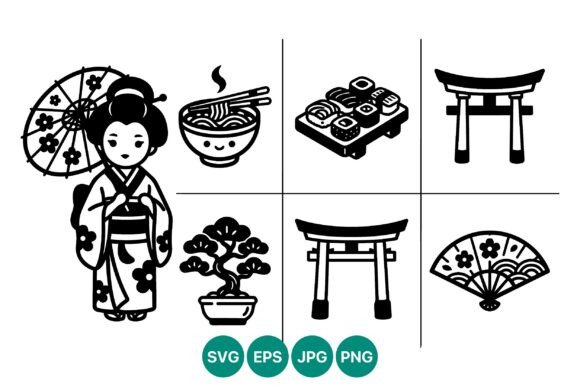
This collection features six distinct, culturally significant symbols: a geisha with an umbrella, a steaming bowl of noodles with chopsticks, a sushi platter, two torii gates, a bonsai tree, and a decorative fan with floral patterns. Each icon is rendered in a minimalist black-and-white style, ensuring versatility across various media formats. The inclusion of SVG, PNG, JPG, and EPS files in the download package means these assets are ready for immediate deployment in both digital and print environments. Understanding how to integrate these icons intentionally can significantly enhance your project’s impact, from improving user experience to strengthening brand positioning.
The Strategic Value of Minimalist Cultural Imagery
When we discuss the utility of Japanese Culture Icons Black White, we are addressing the intersection of aesthetics and function. In design and communication, less is often more. High-contrast black-and-white imagery removes the cognitive load associated with processing multiple colors, allowing the viewer to focus immediately on the shape and symbolism of the object. This is particularly valuable in contexts where speed of comprehension is critical, such as mobile interfaces, instructional guides, or quick-scan marketing materials.
Consider the psychological weight of the included icons. The torii gate instantly signals transition, spirituality, or entry into a sacred space. For a wellness brand or a meditation app, this icon can serve as a powerful visual metaphor for mindfulness and inner peace. Similarly, the bonsai tree conveys patience, growth, and careful cultivation. An financial advisory firm or a long-term investment platform might use this symbol to subtly communicate the value of steady, disciplined growth over time. These associations are not accidental; they are deeply embedded in cultural consciousness. By using these specific icons, you tap into existing semantic networks, making your message more memorable and emotionally resonant.
Furthermore, the monochromatic palette ensures that these icons do not clash with your existing brand colors. Whether your brand identity is built on vibrant reds, calming blues, or neutral earth tones, black-and-white vectors integrate seamlessly. This flexibility reduces the need for custom design work, saving time and resources while maintaining a cohesive visual language.
Practical Applications Across Industries
To maximize the return on your creative investments, it is essential to map these icons to specific business goals and use cases. Here are several strategic applications for the Japanese Culture Icons Black White collection:
- Hospitality and Food Service: The steaming bowl of noodles and the sushi platter are immediate identifiers for culinary experiences. Restaurants can use these icons on menus, wayfinding signage, or social media posts to highlight specific offerings. The high-contrast nature of the vectors ensures they remain legible even when printed on textured paper or displayed on small mobile screens.
- Tourism and Travel: For travel agencies or blogs focusing on Japan, the geisha with an umbrella and the torii gates serve as iconic landmarks. These images can be used in itinerary planners, blog headers, or promotional brochures to evoke a sense of place and adventure. The vector format allows for scaling up to large-format prints without loss of quality, which is crucial for trade show displays or outdoor advertising.
- Education and Publishing: Educators teaching about Japanese history, art, or language can use these icons to break up text-heavy materials, making content more engaging for students. The decorative fan with floral patterns can illustrate chapters on traditional arts, while the bonsai tree can accompany lessons on horticulture or philosophy. The clarity of the black-and-white design makes these icons ideal for worksheets and handouts that may be photocopied.
- Corporate Branding and Stationery: Small businesses and freelancers can incorporate these icons into their letterheads, business cards, or email signatures to add a touch of elegance and differentiation. The EPS and SVG files allow for precise manipulation, enabling designers to adjust line weights or combine elements to create unique logos or watermarks.
Technical Advantages of Vector Formats
A key component of this collection’s value lies in its technical specifications. The download includes SVG and EPS files, which are vector-based formats. Unlike raster images (such as standard JPGs or PNGs), vectors are defined by mathematical equations rather than pixels. This means they can be scaled to any size—from a tiny favicon to a massive billboard—without becoming pixelated or blurry. For professionals who need to maintain sharp, crisp results across multiple platforms, this is non-negotiable.
The PNG and JPG files included in the ZIP folder provide convenience for quick uploads to social media or web platforms where vector support may be limited. However, for long-term asset management, storing and editing the original SVG or EPS files is recommended. This approach future-proofs your design work, allowing you to adapt the icons as your brand evolves or as new media channels emerge.
Risks of Contextless Usage
While these icons are powerful tools, they are not without risk if used without strategic intent. Cultural symbols carry weight and meaning. Using the geisha or torii gate merely as generic "Asian-themed" decoration can come across as superficial or even disrespectful if not aligned with the surrounding content. It is crucial to ensure that the use of these icons respects the cultural context they represent. For instance, using a torii gate in a purely commercial, non-contextual manner might dilute its spiritual significance and alienate knowledgeable audiences.
Additionally, overuse can lead to visual clutter. Because these icons are high-contrast and bold, they demand attention. Placing too many of them in close proximity can create a chaotic visual field that distracts rather than informs. The principle of restraint applies here: use one or two icons to anchor a section or highlight a key point, rather than scattering them indiscriminately throughout a layout.
Decision-Making Framework for Implementation
Before integrating Japanese Culture Icons Black White into your next project, consider the following decision-making framework:
- Define the Objective: What is the primary goal of this visual element? Is it to inform, decorate, or brand? If the goal is branding, ensure the icon aligns with your core values. If it is informational, ensure it clearly represents the content it accompanies.
- Audit the Audience: Who will be viewing this material? Are they familiar with Japanese culture, or will they need additional context? Tailor the surrounding text to support the icon’s meaning if necessary.
- Check Technical Requirements: Determine the final output medium. For web use, optimize SVGs for file size. For print, ensure EPS files are correctly embedded. Test the icons at various sizes to ensure legibility.
- Evaluate Cultural Fit: Does the icon enhance the narrative, or does it feel forced? Authenticity resonates with audiences. Ensure that the use of the icon feels natural and relevant to the story you are telling.
By approaching the use of these icons with a strategic mindset, you transform them from simple graphics into effective communication tools. The Japanese Culture Icons Black White collection offers a blend of aesthetic beauty and functional versatility. When used with intention, these icons can elevate your projects, clarify your messages, and create a lasting impression on your audience. The key lies not just in having access to high-quality assets, but in understanding how to deploy them to achieve specific, measurable results.
Ultimately, the value of this collection is realized through thoughtful application. Whether you are designing a website, creating educational materials, or building a brand identity, these icons provide a solid foundation for visual storytelling. They allow you to communicate complex cultural ideas with simplicity and grace, supporting your broader goals of engagement, clarity, and professional excellence. As you plan your next creative endeavor, consider how these timeless symbols can help you articulate your vision with precision and impact.